
Interview with Yvonne John
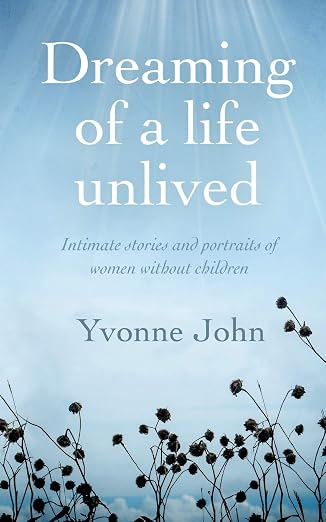
Dreaming of a Life Unlived really came out of frustration, anger my own need to understand what was happening to me.
When I was diagnosed with unexplained infertility in my early forties, I was completely unprepared for the grief that followed. I remember sitting in my fertility consultant’s office and being told that there was no identifiable reason why I couldn’t conceive. I was almost 44, and although I wasn’t actually told that I would never have a child, somewhere inside me I knew that motherhood probably wasn’t going to happen for me.
What surprised me was the depth of my grief. I was grieving someone who had never existed, a child I had imagined, a future I had assumed would be there. How do you explain that kind of loss to somebody else when you’re struggling to understand it yourself?
There was also shame. I’d had two terminations in my twenties and, although there was no suggestion that they had caused my infertility, emotionally I blamed myself. I told myself that perhaps I didn’t deserve to grieve because I’d once chosen not to become a mother.
Eventually, I found Jody Day and the childless community Gateway Women. Whilst on the year long Plan B Mentorship programme I discovered other women describing feelings that sounded like mine. Suddenly, I wasn’t alone and I wasn’t imagining the magnitude of this loss. The book grew from that place. I wanted to create something that said: this grief exists. These women exist, we exisit. And our stories deserve to be heard. I wanted to give us our voices back. So, I brought together my story with the stories of other women grieving the loss of motherhood. It became not simply a book about what we had lost, but about women trying to find creative, meaningful and fulfilling lives when the life they imagined didn’t happen.
There isn’t one universal experience of childlessness. Our stories, circumstances and the way we experience being without children can be very different. Something I see repeatedly and something I experienced myself is the struggle with grief, often coupled with a profound sense of isolation.
I don’t believe there is a hierarchy of grief, but this particular grief can be difficult to understand because you’re grieving something you never physically had. There is no funeral. There may be no recognised moment of loss. There may not even be anyone around you who understands why you’re grieving. Which adds to the complexity of realising and therefore accepting that you’re grieving. And yet, you’re grieving an entire imagined lifetime. We’re grieving what we hoped for, the future we assumed would be ours, and often what society has told us we should be able to accomplish as women.
For me, it wasn’t simply, I’m not going to have a baby. It was realising that I would never hear my child call me Mummy. I wouldn’t take the first day-of-school photograph. I wouldn’t meet their first boyfriend or girlfriend. I wouldn’t watch my parents build memories with my children. I wouldn’t grow older and have the privilege of seeing the person my child became. You’re grieving all of those future moments at once. And the difficulty is that life keeps presenting you with reminders of what you haven’t got or, as many women internalise it, what you somehow “failed” to do. A friend’s pregnancy announcement. A child’s school play. Watching a family together on a train. Hearing your parents talking about their grandchildren. Things that can be completely ordinary and joyful for somebody else can unexpectedly open the wound again.
Perhaps one of the hardest struggles is feeling that you have to carry all of this quietly because the world doesn’t always recognise that there has been a loss. There can be a loneliness in having something so significant happening inside you while the rest of the world carries on as though nothing has happened.
And then there is another kind of loss that we don’t talk about enough: the loss of our place within our families, friendship groups and communities. You can begin to question: Where do I belong now? What do I have of value to offer? Where is my place when everybody else’s lives seem to be moving into parenthood (and beyond) and mine isn’t?For some women, this leads to what Jody Day describes as the “friendship apocalypse” – friendships changing or disappearing as people’s lives take different paths. And even when we’re fortunate enough to maintain those friendships, there can still be those painful, awkward moments: “I didn’t invite you to X’s birthday party because I didn’t think you’d want to come.” Often it is said with kindness. Someone believes they’re protecting you. But what you can hear underneath it is: You don’t belong in this space anymore.
So, if I had to identify one of the most common struggles, I would say it is grief intertwined with isolation and belonging. It’s not only grieving the child you didn’t have. It’s grieving the imagined future, the identity of motherhood, the relationships that may change, and sometimes even your sense of where you fit in the world.
And I think one of the things childless women need most is for that grief to be recognised not fixed, minimised or compared with somebody else’s loss, but simply acknowledged as something real.
There are so many stereotypes attached to women who didn’t have a child of their own. Before I knew I would be one of those women, I had absorbed some of them myself. I imagined the stereotypical childless woman as sad, lonely, perhaps someone who didn’t like children or didn’t like men. Or she was the career-obsessed woman who had deliberately chosen her career over motherhood. And, of course, there’s the infamous woman surrounded by cats!
I often joke that I don’t fit the stereotype: I love children, I was married, I like to think I’m fabulously glamorous and I’m allergic to cats! But underneath the humour is something quite serious. Women are still very strongly associated with motherhood. So, when a woman doesn’t have children, people often want an explanation.
“Didn’t you want them?”
“Have you tried IVF?”
“Why don’t you just adopt?”
Sometimes we’re treated as though there is something missing from us or as though our lives are somehow less complete. Those assumptions can also enter the workplace. People without children may be expected to work unpopular shifts, cover holidays or take on additional work because their time outside work is perceived as less important.
One of the things I challenge is this idea that motherhood is what validates womanhood. A woman does not have to be a mother for her life to have meaning.
My main objectives with my book was/is to give women loke me our voices back. I want women living with the unrealised dream of motherhood to feel seen.
There’s a line in the book that describes it as: “a silent sadness that cannot be spoken about and that others cannot bear to hear or feel.” That captured something incredibly important for me. So much of this experience happens silently.
I wanted the woman sitting alone thinking, Why am I still hurting? Why can’t I just get over this? Why does everyone else’s life seem to be moving forward while mine has stopped? to recognise herself somewhere in those pages. I also wanted her to see that her story doesn’t end there. That it is possible to build a fulfilling, meaningful life without children even if that life looks very different from the traditional version of womanhood and motherhood that many of us were taught to dream of. The dream may not have unfolded in the way it was sold to us, but that doesn’t mean there aren’t other dreams to dream, other ways to love, to nurture, to leave a legacy, and to live a life that is fully our own.
I want people who do have children to read the book. Because this isn’t only about giving a voice to women without children. It’s about helping wider society understand an experience that is so often invisible.
And importantly, the book isn’t saying that a meaningful life ends when motherhood doesn’t happen. It’s about grief, yes. But it’s also about rebuilding. It’s about identity. It’s about finding belonging.
And ultimately, it’s about asking: If the life I imagined isn’t going to happen, what life can I create from here?
Dreaming of a Life Unlived was, in some ways, my tongue-in-cheek nod to and celebration of my own “baby” being conceived and birthed into the world. My book became something tangible that emerged from an experience that had felt overwhelmingly about absence. I once joked during a talk that in 2017 my baby (girl) was finally born and then held up my book. Everyone cheered. Later, a woman came up to me and asked where my daughter was because she wanted to meet her. She hadn’t realised I was talking about the book.
That moment stayed with me because it showed me just how strongly we’re conditioned to expect this kind of story to end with a baby. We hear about the struggle, the infertility, the heartbreak and somewhere in the story we expect the miracle pregnancy and the happy ending. But mine didn’t end that way. My book wasn’t a replacement for the child I didn’t have. I think that’s really important to say. You can’t replace the dream of motherhood with a book, a career, a business, a pet, or anything else and say, “There you go, that should make everything okay.”
What the book did give me was a way of taking something that had been almost entirely internal – the grief, the questions, the shame, the things I couldn’t articulate – and giving it a voice and a physical form. There was something quite powerful about being able to hold this book in my hands and know that something had been created from a period of my life that had felt so defined by what hadn’t been created.
Writing didn’t magically remove my grief. It didn’t make me stop wanting the child I had imagined. But being able to speak it, write it and share it meant I was no longer carrying all of it silently. This is what the birth of Dreaming of a Life Unlived represents for me: not a replacement baby and not the consolation prize at the end of infertility, but something meaningful that I was able to bring into the world from an experience of profound loss.
I think that’s important when we talk about faith, hope, positive affirmation and the expectation of conceiving, because we love the miracle baby story. We know how to celebrate the woman who struggled with infertility for years, held onto hope and eventually became pregnant. Her prayers were answered. She got the ending everyone had been hoping for. But we don’t talk nearly enough about the woman who also hoped, prayed and believed and whose story doesn’t end with a baby. Where does she place her faith? What does she hope for? What does positivity look like when being positive cannot change the outcome we longed for?
I think we have to be very careful with the language of faith and positive thinking because I would never want a woman to believe that she didn’t conceive because she wasn’t positive enough, didn’t have enough faith, didn’t pray hard enough or somehow didn’t want motherhood enough. For me, there came a point when I had to stop chasing what I describe as the ghost of motherhood. I wasn’t chasing the expectation that I would miraculously become pregnant; I was still holding onto and grieving the imagined life and identity of motherhood – the woman I thought I would become and all of the experiences I thought would come with her.
Acceptance didn’t mean that I suddenly liked what had happened. It didn’t mean that I thought it was fair. And it certainly didn’t mean that I hadn’t wanted motherhood enough. It meant beginning to make peace with the reality of where I was and allowing myself to ask what a different life might look like.
And that’s where hope began to take on a different meaning. The hope changed from I hope I will have a baby to I hope I can build a life that is meaningful, connected and fulfilling – a life that honours the woman I am while still making space for the grief of the mother I had hoped to be. Positive affirmation changed alongside it. Rather than being about telling myself, “If I believe hard enough, this will happen,” it became about affirming the value of the life and the woman who were already here:
My life still has value.
I am still a whole woman.
There are still things for me to discover, create, love and become.
Faith had to change too. Faith didn’t have to mean believing that I would eventually be given the thing I had prayed for. It could also mean having faith that a different life could still hold meaning, love, connection, purpose and joy.
So, in Dreaming of a Life Unlived, faith and hope aren’t about promising women that their baby will eventually come. They’re about making room for grief and for the reality that sometimes the thing we desperately wanted doesn’t happen, while still holding onto the possibility that our lives can be meaningful and fulfilling. For me, that is where hope now lives – not in waiting for a different ending to my story, but in continuing to discover what is possible within the life that is mine.
The writing process actually began with a moment when I felt incredibly inadequate. I was at a women’s networking event and, as part of an icebreaker, we were asked to introduce ourselves. As we went around the room, woman after woman introduced herself by saying, “I’m a mother…” or “I’m a grandmother…” And then it came to me. I remember sitting there thinking, What am I going to say? Who am I? What have I accomplished? Of course, I had accomplished things. I had a career, an education, a home, relationships, I’d travelled – I had a whole life of experiences. But in that moment, surrounded by women proudly naming motherhood and grandmotherhood as part of who they were, somehow none of my achievements felt enough. I felt as though I had failed to achieve the one thing that defined womanhood in that room.
I spoke about how that experience had made me feel, and the organiser, Helen Tucker, heard something in what I was saying. She told me that she would help me get my book written. And she did.
Helen coached me through the process. She encouraged me to gather together other women who were also living with the unrealised dream of motherhood and helped us create a space where we could begin telling our stories. She ran a workshop with us that helped break down something that initially felt enormous: how do you take all of these experiences, memories and emotions that are living inside your head and somehow put them onto paper? The stories emerged gradually. We had to find the words for experiences that many of us had spent years not talking about.
As those stories came together, I began to see the threads connecting us. Our circumstances weren’t identical and our experiences of childlessness weren’t the same, but there were emotions and questions that echoed across our stories – grief, shame, identity, relationships, belonging, acceptance and that enormous question of, What does my life look like now? Those common threads helped the book begin to take shape.
So, when you ask how the sentences became paragraphs, the paragraphs became pages and eventually became a book, for me it started much earlier than the sentences. It started with women sitting together and finding the courage and the language to tell the truth about their lives. Helen helped us get those stories out of our heads and onto paper, and from there I was able to begin weaving those individual experiences together into Dreaming of a Life Unlived.
And there’s something quite poignant about the fact that the book began in a room where I initially felt I had nothing significant to say about myself. Because ultimately, finding my voice in that room led me to help create a book in which women whose experiences were so often unspoken could finally say: this is my story too.
I haven’t authored another book since Dreaming of a Life Unlived, and I’m not currently working on another book of my own. However, I’ve been very fortunate to contribute my story, experiences and voice to a number of other books exploring childlessness, infertility, motherhood and women’s lives. These include
Jody Day’s Living the Life Unexpected,
Lois Tonkin’s Motherhood Missed,
Emma Haslett and Gabriella Griffith’s Big Fat Negative,
Kat Brown’s No One Talks About This Stuff, and
Kaye Adams and Vicky Allan’s Still Hot” 42 brilliantly honest menopause stories.
I actually feel very proud of those contributions because they represent something much bigger than simply being included in another person’s book. When I first began talking about childlessness, so many of these experiences were happening quietly and behind closed doors. Being able to contribute to other women’s work means that my story has become part of a much wider conversation and, importantly, part of helping other women recognise that they aren’t alone.
So, while there isn’t another Yvonne book waiting in the wings at the moment, I haven’t stopped telling stories. My voice has continued through my speaking, advocacy and contributions to the work of other writers.
One of the biggest challenges was that I wasn’t writing about something safely contained in my past. I was writing from inside an experience I was still trying to understand and, in some ways, still learning how to grieve. Probably the most difficult part for me was writing about the two terminations I had in my twenties. Initially, I wanted to leave them out. I carried shame about those decisions (at the time I called them mistake), particularly after I discovered that I wasn’t going to become a mother. There was a part of me that questioned whether I even had the right to grieve being childless because I had previously been pregnant and had chosen not to continue those pregnancies.
That shame had a profound impact on my ability to grieve. I had created this narrative in my head that perhaps this was somehow my fault, or even my punishment and also that others wouldn’t accept my grief because I had given up my chance to be a mother all those years ago. So, when I started writing the book, I wanted to hide that part of my story. But I realised that leaving it out would be disingenuous because you couldn’t fully understand my experience of childlessness without understanding the shame I was carrying alongside it. I reached a point where I thought: I either tell my whole story or I don’t tell it at all.
Part of working through that involved writing a letter to my younger self. I needed to forgive her. I told her that I understood the decisions she had made. Those decisions weren’t made because she didn’t care about those unborn children. In many ways, they were made from love. At that point in her life, she wanted better for them than she believed she was able to give them. That was incredibly important for me because I had spent years judging my younger self through the eyes and circumstances of the older woman I had become. Writing the letter allowed me to meet her where she had been.
Writing the rest of the book could also be emotionally difficult because writing about grief often means revisiting it. There were memories and feelings I had spent a long time trying not to look at too closely – my infertility diagnosis, watching other people’s families grow and slowly recognising all of the experiences I would never have with my own child.
There was also the responsibility of holding other women’s stories. These weren’t characters I’d invented. These were women’s lives, grief and vulnerabilities, and I felt a responsibility to treat what they had entrusted to me with care.
What ultimately helped me cope was doing my own grief work. I began to understand that acceptance didn’t require me to pretend I wasn’t hurt or to somehow become grateful that motherhood hadn’t happened for me. I could say I wish things had been different. And at the same time say This is the life I have, so how do I want to live it?
And even since the book was published, telling my story can still bring the difficult emotions back. I don’t think publishing a book puts a neat full stop at the end of grief. There are still things that can catch me unexpectedly. The difference is that I now understand those feelings better. I don’t have to silence them, judge them or believe that their return means I have somehow gone backwards.
Perhaps one of the greatest things writing Dreaming of a Life Unlived gave me was permission to hold all of my story – the decisions of the younger woman I was, the grief of the woman who wanted to become a mother, and the life of the woman I am today – without having to erase one in order to honour another.
I actually find this question quite difficult because, for me, it reflects one of the narratives I’ve spent years trying to challenge – the idea that somehow, no matter what, motherhood still needs to be the ending to my story.
The reality is that I didn’t become a mother, and I’m not going to become a mother.
There was a time when saying those words would have been incredibly painful. But through doing my grief work, and through the advocacy work I’ve done over the years, I’ve reached a place where I can say: I’m okay with that. That doesn’t mean I didn’t want motherhood. It doesn’t erase the grief or the life I once imagined. It simply means I’ve stopped waiting for my life to become something else before I allow myself to fully live it.
And I have an amazing life.
That’s actually one of the messages I want society and the women coming up behind me to hear. We have to be allowed to sit with the reality that sometimes motherhood doesn’t happen. We have to be allowed to grieve that without constantly being encouraged to keep hoping for a different ending. Because there is life on the other side of that grief.
My life isn’t a waiting room for motherhood. This is my life. And rather than asking what I would do differently if I finally became a mother, I’m much more interested in what I can continue to create, experience, love and become with the life that I already have.