

Interview with Rosemary Keevil
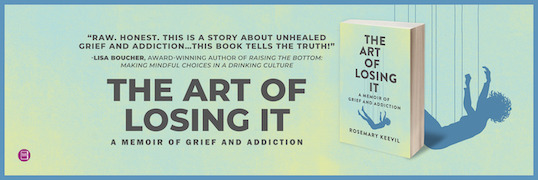
The answer to this is short and simple: Life handed me a bad rap. I am a journalist. What to journalists do? They write. I had a story to tell so I wrote about it.
I was living a charmed life. I had an interesting career in the media, a doting husband and two precious little daughters. Then disaster struck like a thunderbolt. Two loved ones were diagnosed with terminal illnesses and died within the year. I plummeted into addiction. Eventually, I crawled back out only to find a brand-new type of chaos in my face. I survive all of this and burst out the end with a message: You too can survive all of this, and maybe even with humor and irreverence infused into the journey.
As a journalist it was second nature to thoroughly research non-Hodgkins Lymphoma and AIDS. In addition, I recorded everything that happened day in and day out in a reporter’s steno pad which was in my purse at all times. I had also hoarded all the hard copies of medical information such as appointments, test results, etc. I combed through these old files and notes to ensure I got all the medical details correct.
The first draft of my memoir was a disaster. My editor wrote me: “Your background as a journalist gives you a disadvantage here because journalism is all about telling. It’s about informing the reader of what happened. Memoir is the opposite. It’s about evoking emotion.” If I am to believe my reviews, my finished product (my memoir) evokes emotion quite successfully.
As it turns out, I had two personal diaries which provided treasure troves of emotions. I had kept my own detailed journal of the months when my husband and brother were dying. I was also very fortunate to have a diary my husband wrote during his last two months of life. In it, he writes: “I was sorting all my banking files and pictures etc. and realized that maybe if I spent the little energy that I have on a diary about my thoughts and feelings it might be more interesting for Rosemary than my 1986 car insurance.” As it turns out it reads like a love story—exuding love and adoration and appreciation for me.
When I first wrote the book, I was motivated by the need to write about it. As it turns out that was therapeutic. But more importantly, I learned it was actually a resource for people suffering the same fates as me. This became a motivating factor for my second research book on grief and addiction which I am working on now.
I was a “high functioning” alcoholic and addict as I was able to keep my job as a current affairs radio show host. I simply did not drink or snort or pop pills when I was going to air. Well, maybe once I did snort a couple of lines in the station bathroom, but I quickly learned never to do that again. So, I would get up very early and do my show—it was during the morning drive slot—go home, nap, get up, get the kids from school and then indulge in mind-altering substances. That does not mean I was not irresponsible. I did drink and drive. It just meant it looked like, to the outside world, that I was still functioning, as opposed to the homeless addict on skid row. That does not, by the way, make me any better than the homeless addict on skid row: I was tormented by the same internal demons and I was heading along the same path, until I entered rehab in 2002.
My daughters were 13 and 15 when I got clean and sober and you’d think that once I cleaned up my act all would be rosy. But it was quite the opposite. All of a sudden, I tried to have rules, curfews (Imagine that!) and they rebelled. My thirteen year old even said, at one point, “I wish you’d never gotten sober.”
A new brand of chaos was introduced into our lives when I changed. I’ve learned that we had been functioning in a dysfunctional equilibrium—a term used in the family systems theory. It doesn’t mean that dysfunctional equilibrium isn’t chaotic, just that the reactions of the family members within the chaos are predictable and this predictability is threatened when sobriety is introduced into the equation.
So, we had to really go through turmoil and break down all the old dysfunctional coping mechanisms and try to build new ones. This is a process and it requires a lot of work, a lot of therapy and we’re still works in progress.
This route is not uncommon among those people getting clean and sober.
I’m proud to say, I must have done something right because both daughters are happily married with fulfilling careers. This doesn’t mean their roads have not been rocky but that is their story to tell, or not.
I realized, as I said above, that my memoir served as a resource for people whose lives had also been turned upside down by grief and addiction. But I felt there was more to add: I wanted to bring relevant facts to the table that supported the story in my memoir.
I am researching specifically about when the death of a loved one leads to addiction or alcoholism, as this is what happened to me. This research book consists of interviews with experts on grief and addiction as well as with people who have been through the ringer with grief and addiction.
The Truth About Losing It: Voices on Grief and Addiction will be published in 2028, so I am currently conducting the interviews. I am discovering interesting facts. For example, brain functioning changes in a similar way when one is grieving and when one is addicted.
I write articles on grief and addiction. For example, one story I am researching now is about the studies currently being conducted using naltrexone, the drug used for addiction, to treat grieving.
I cannot finish any piece of writing without a deadline so, for my memoir, I hired an editor and manuscript consultant, Brooke Warner, who is in Berkley, California. I had deadlines: one chapter on the first of every month. Brooke also happens to be publisher of She Writes Press who published my memoir. It was an easy transition from completed, edited manuscript to publisher.
Brooke Warner is a dynamo, a publishing expert and TEDx speaker. She Writes Press is a hybrid press, which means your manuscript needs to qualify and then you pay their professional services which include: traditional distribution; proofreading of final manuscript; copyright filing in US; warehousing books; support for getting books into bookstores, libraries, and other trade outlets; custom cover and interior design, and e-book file conversion.
I would be very diligent when researching self-publishers, certainly more diligent than I was for my second book. I thought I did decent research. But, in hindsight, I guess the name of the outfit should have been my first clue: Amazon Publishing Pro. Now, that’s a little shady. I knew damn well they were not THE Amazon. They were just piggybacking on that name. They were more interested in the social media campaign than giving me a clean, edited version of my manuscript. I ended up firing them and not getting my money back.
Then, I went to the publisher of my memoir, She Writes Press.
The reason I did not go to She Writes Press originally was because I had assumed that my new book was not up their alley. As it turns out, it is. But Brooke wants so many changes that I basically have to go back to the drawing board and do more research, including conducting more interviews, which I am currently doing.
Readers can find my book on Amazon.