
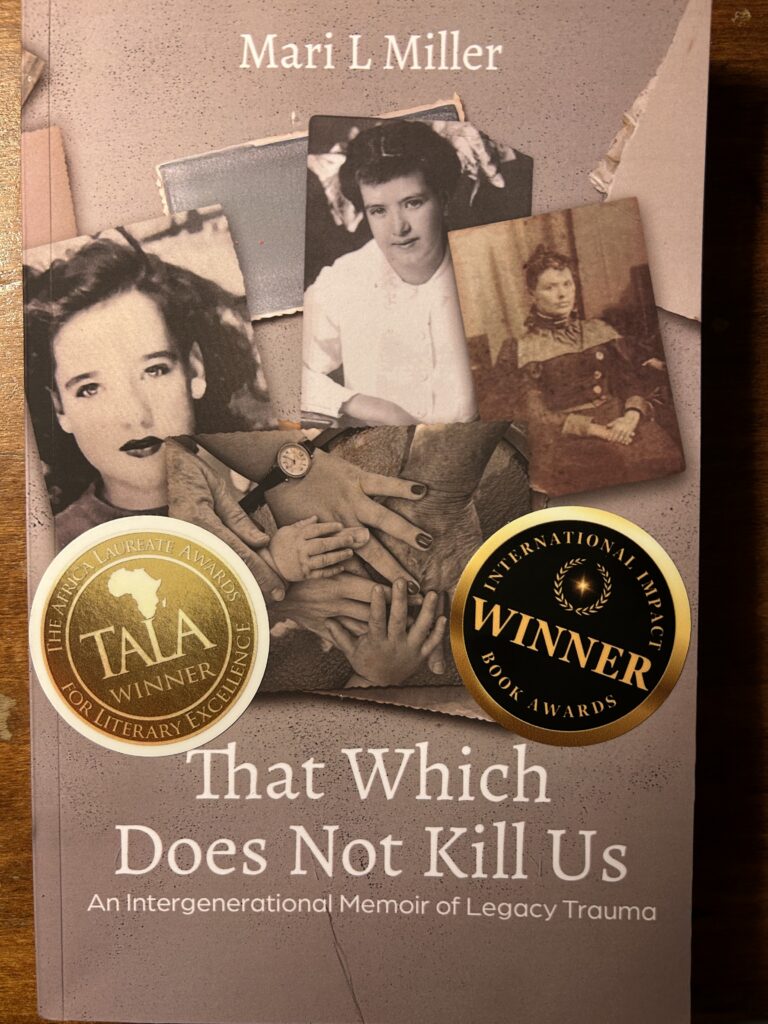
Question 1: When did the shift from seeing Annie as a character to a real person occur? Was it frightening to suddenly see myself in a woman who has been dead for nearly a century?
I wish the shift had happened about 25 years ago when I used her diaries as the basis of my one-woman-show about her chasing the cure for tuberculosis. I had only received a copy of her diaries a few years before, so I hadn’t done the kind of research into her life and the time period that I did for the book. I had the photographs of her, but I didn’t study and scrutinize them like I did when I was writing the book. The shift, though, started when my first granddaughter was born four years ago, and I started noticing what I looked like in photographs that now hang on my daughter’s walls. These will become the photographs that my granddaughters and their children, if they choose to have any, will look at. But they’ll also have videos of me to hear my voice and see my mannerisms. I won’t be as much of a stranger to them. I never knew my maternal grandmother, who died when my mom was three, so she never knew her either. We had no way of knowing if we inherited any of her or my great-grandmother’s mannerisms. Those mannerisms would’ve come in handy when I portrayed my great-grandmother in my one-woman show. And because of that portrayal I did not find it frightening to see myself in a woman who’s been dead for 93 years. I finally felt a connection. I didn’t grow up with many of my mom’s relatives so writing this book gave me a grandmother and great-grandmother who had been lost to me my entire life.
Question 2: What do I believe was in those cut out pages from Annie’s diaries? Has my answer changed since first reading the diaries in 1999?
Those years 1911-1926 were tough years for Annie. Her daughter Marjorie, my grandmother, developed polio. Annie’s husband died. Two of her brothers died, one of whom she lived with in Colorado when she was chasing the cure for tuberculosis. Her mother died. There was a lawsuit dealing with one of her brother’s widows. It’s very possible she had unkind words for some of these people and events and upon re-reading those words, she felt it too cruel for others to read them and so cut them out. I believe cutting them was a deliberate, malicious act. Ripping them out would’ve been more of an impulsive, passionate act. So, who committed this deliberate act of forever removing Annie’s words from these years? I don’t think it was Annie because she mentioned in a couple different diary entries that she hoped others in years to come would find her life interesting. Talking only about household chores and ordinary life events wouldn’t be enough. The most likely culprit is her older daughter, Maysie, my great-aunt, to whom the diaries went after Annie died in 1933. I think there were revelations that Aunt Maysie didn’t want anyone else to know about. That deliberate act of cutting out the pages does Annie an injustice. I believe she wanted her descendants to know the suffering she endured and see that she never gave up. When I first read the diaries in 1999, I was mystified and slightly perturbed that fifteen years were missing. Then when I learned about many of her sad life events that happened, I started to ruminate and speculate. I am much angrier now to think Annie took great pains to ensure her diaries endured, and yet fifteen, emotionally charged years are lost. It does her an injustice. Maybe because I’m nearly the age Annie was when she died, I wanted to make sure my memories weren’t cut up or deleted. You can’t go much more public than publishing a memoir. The most common feedback I get from people who are willing to tell me their thoughts about the book say, “You were so honest. That takes a lot of courage to be that honest.” I do make some brutal revelations about myself in the book, and, yes, that was intentional. I want my family to know now and in the future that the women from whom they come are badasses!
Question 3: Do I still believe a different final conversation with Mom in the ICU was possible? Has writing the book changed this?
I don’t believe it would’ve ever been possible for us to have had a different conversation. I didn’t even realize I was suffering from unresolved childhood trauma until my daughters became clinical mental health therapists, and that was after Mom had been dead for a decade or so. Mom was raised from the age of three by an aunt, so she never received the love and attention her same-aged cousin did. Since Mom never received it growing up, she never knew how to give it when I was growing up. My daughters had to become mental health experts for them to realize what was missing in my life was repeating in what was missing in theirs…..emotional connection. Thanks to them, I’m learning how to be more emotionally open and available. If Mom and I had ever been able to have those heart-to-heart talks, I would’ve never written the book. I wouldn’t have needed to.
Question 4: What does it cost me to re-read the pages I wrote about Madison’s feelings of invisibility? Has Madison read them?
Yes, Madison read them. She and Mackenzie were my first readers on every chapter to make sure I didn’t reveal anything they didn’t want to reveal. I wrote most of the book while living in Maddy’s basement because I live with her and her family during the week when I’m taking care of my granddaughters. There was one night I remember she came down to my bedroom after reading my chapter, which is chapter six. She crawled in bed with me and was just sobbing so I just held her until she could tell me. She hadn’t realized that I had felt that same sense of invisibility when I was little and my mom was sick. That’s one of those parallels across generations, and it took writing this book for me to see I had put her through the same emotional distancing that I had gone through. It’s cathartic now to re-read those pages and know that we came through it stronger.
Question 5: When did the shift from seeing Annie as a character to a real person occur? Was it frightening to suddenly see myself in a woman who has been dead for nearly a century?
My goal when I started the book was to prevent the legacy trauma from spreading down to my granddaughters. I was four when my mom had her first cancer in 1968. The surgery she underwent for ovarian cancer resulted in blood clots and radioactive treatments that required her to stay in the hospital for a couple of months. At that time, children under the age of 12 weren’t allowed on the patient floors, no exceptions. I was four years old and didn’t understand where my mother was. But the part that still saddened me 50 years later was that no one remembered who took care of me. I never asked my mom because, as we’ve already talked about, we didn’t have that kind of emotional relationship. But no one in my family knew where I was while Mom was in the hospital and Dad was working during the day and visiting her at night, without me. Through process of elimination, I had to figure out who was taking care of me. When Maddy ended up back in the hospital five days after Amelia was born, I didn’t fail to see the parallel with Grace being three at the time. I was determined Grace wouldn’t feel the same loss of her mother, even for a few days. I never asked for permission to bring Grace to her mother’s hospital room where her father and newborn sister were also having to stay. I just went straight to the room. I didn’t consciously think about it, I acted on the instinct that no child should be kept from her mother.
Question 6: What did it feel like to write about Marjorie with such an absence of information? Do I feel like I found her?
When I made the decision to give each generation her own chapter, I knew Marjorie’s chapter was going to be shorter. During the midst of writing the book, however, my brother Ron received a letter from a distant cousin who had an original letter written by our great-aunt Maysie about the last days of our grandmother’s life. Because of that letter, I saw the strength and determination of my grandmother to survive 90% of her body suffering first-degree burns. But I also saw her sense of humor amidst such pain when she told Maysie that she smelled like a burnt hog. Finding the clippings of her hair was probably when she first became real to me. To be able to feel her hair might sound macabre, but it brought me to tears that I could touch something that once touched her. Although she was born in Illinois and lived most of her life in Colorado, she lived for a few years in the town where I grew up. Researching those local newspapers and seeing references to the places she went, and the people with whom she interacted showed me she had probably walked some of the same places I had. Up until that point I had only ever referred to her as Marjorie, but after that I was able to call her Grandma.
Question 7: When did I stop seeing acts of service as a failure and start seeing it as something more complicated — a language of love that is limited but real?
I don’t think I’ve seen it as a failure so much as my default. I used to teach my interpersonal communication students about Dr. Chapman’s five love languages that he introduced in 1992 to show how people prefer to give and receive love. This was probably when I realized that my mom did indeed love me, but she showed it with her actions more than her words. Each of the five languages, acts of service, gifts, words of affirmation, touch, or quality time, provides an emotional connection. For example, my daughter Mackenzie was hospitalized the first week of this year so during some of that stay, I cleaned out her refrigerator and freezer. She was grateful, but, more importantly, she recognized it as my way of showing her my love and support. I know her love language is touch so when I go to her house for dinner several nights a week, we sit on her couch and talk, and I give her hugs when I arrive, when I leave, and sometimes during dinner, if I see she’s having a rough day. We all have our preferred ways of giving and receiving love so even though I give love through acts of service, I prefer to receive it through quality time spent together. My least favorite is gifts, so instead of birthday gifts, for example, I’d rather have a family dinner with card and board games. Whether it’s a romantic or a familial relationship, we need to know what the other person needs to receive, and that person needs to know what we need to give.
Question 8: How long did I live with the realization that I chose to abandon my husbands first before I could write it down? What happened in the space between knowing it and being able to say it?
This truly was an epiphany, and I wrote it down as soon as it came to me. Writing this book forced me to look at the patterns in my life and why they kept appearing. Certainly, one of those patterns was my inability to maintain long-term relationships. When I read Dr. Atlas’s book about emotional inheritance, I realized the relationships I had with my parents, especially my mother, were indicators of future relationships. This meant that if I was going to have any future relationships, I had to deal with the abandonment issues I’d been carrying around since I was four. When I talk with people about my book, I tell them everyone should write a memoir, even if it’s just for you and your family. The introspection required to dissect your own life is difficult and often painful, but in my case, completely worth it.
Question 9: What do I most need Grace and Amelia to understand about me as a person?
That I have a potty-mouth, and I’m not perfect. That I am silly and strong and a survivor. That I look deeply at the world around me to promote what I love and believe in and change what I can. That I lived my life with purpose and tried to leave this earth better than when I arrived on it. That I can break into song and dance without provocation, especially in the kitchen. Mostly, I want them to know I lived many lives in one as I tried on different hats: some I continue to wear; some I bring out for special occasions; and some are packed away with moth balls only to be thought about. Failure is just as important as success because it can push you even harder. And I’m still a work-in-progress…..will be until the day I die.
Question 10: Have I managed to evict previous generations from my life or do they still show up uninvited? And when they do, what do I do with them now?
I evicted their legacy of trauma, but in its place, I found family. It’s not so much that they show up uninvited, but I feel them at various times, and I invite them to sit for a bit. It’s a strange position to be in, to know your family better after they’re dead than when they were alive. Over time when any relationship ends, whether it’s due to death or divorce, we eventually remember more of the good stuff than the bad stuff. But it’s all that stuff that makes a person, and I’m thankful I got to learn some of the bad stuff because they became real people, FAMILY, and not just characters in stories.