
Judy A. Bernstein on They Poured Fire on us from the Sky
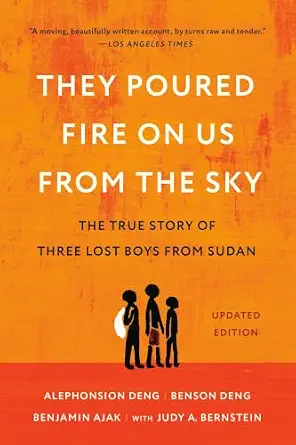
Judy A. Bernstein is an American author who has worked extensively with refugees of the Sudanese civil war and co-authored two books recounting their personal experiences. They Poured Fire on Us From the Sky: The True Story of Three Lost Boys of Sudan, was written with Sudanese brothers Alephonsion Deng and Benson Deng, and their cousin Benjamin Ajak and published in 2005. A follow-up book, Disturbed in Their Nests: A Journey from Sudan’s Dinkaland to San Diego’s City Heights, was written with Alephonsion Deng and published in 2018
Peter: It’s great to have read They Poured Fire on us from the Sky. It was a striking story, an emotional one, and the cover design is so astounding. Uhm, I would like to start my questions with the book’s collaborative narration, which is a super impressive one. The book combines three voices, Alepho, Benson, and Benjamin. What challenges did you face in ensuring each perspective was distinct yet cohesive in the narrative? The choice of switching between characters. How did you manage that?
Judy: When I met these young men, I’d been learning to write for about ten years. I’ve always been an avid reader. They asked if I’d correct their English if they wrote. The writing evolved from little bits on paper to Word files emailed over the first year. Their voice was so unique to an American, as are most African voices. Lyrical and full of fresh metaphors. And then of course their stories evolved for me as they told more. They wrote about things they didn’t talk about. The first version of the book I submitted for publication was anchored by my experience and voice. As newcomers to our country, they were overwhelmed with creating a new life with little time to write.
A brilliant British editor, Clive Priddle, liked it but wanted it to be just their voices. This was 2004 so their lives were more settled and they wrote more. Our priority was to maintain the integrity of their voices and the individuality of their experiences. In the news, it can sound like everyone is enduring the same situation, and suffering. But readers relate to individuals and each person has a unique struggle. The writings they gave me were distinct, so I just had to keep that aspect. But they did not write in chronological order, so putting them into something understandable was a big challenge. They had Dinka names for places and things. They were just learning English. Maps and information on South Sudan were scarce. The Internet was still a baby. I had pieces of paper pasted all over every wall of my office. And…. I had known them for a couple of years at this point. It was heartbreaking to discover over time what they had endured. That fueled my determination to rewrite the book.
Peter: In balancing emotion and clarity: How did you decide what details to include or exclude to strike a balance between emotional impact and factual clarity?
Judy: Since this is non-fiction, a memoir, keeping it factual from their point-of-view was the only choice. However, people remember things differently. Because their whole story is a crisis, I had to find a story arc. Separation became my theme. Separation from parents and family, of course at such a young age, but also the 5-year separation of Alepho and Benson and their reuniting. In terms of the emotional component, they told their stories by “showing” not “telling” leaving it to the reader to fill in those emotional pieces. If I did add an emotional reaction, they often took it out.
Peter: Considering cultural detailing: Were there aspects of the Sudanese culture or traditions you felt were particularly important to include, and how did you approach explaining them to an international audience?
Judy: Excellent question. They were trying to learn American culture. For them, Sudanese culture was the norm, so it took time for us to understand the differences, and we still are. Our second book, Disturbed In Their Nests, is about the first year in America told by Alepho and myself and really shows our misunderstandings of each other due to cultural differences. I’d say the first book is more about their experience surviving a genocide in their home country. The second book is our discovery of our similarities and differences, and surviving those. Writing the second book more than ten years later, was quite illuminating for both Alepho and me.
Peter: Considering adapting the story: If the story were to be adapted into a film or play, what elements would you INSIST remain faithful to the book?
Judy: My mission in telling this story (other than to help them) was to show the impact of war and displacement on the individual. People are not collateral damage. We are isolated from this in America, yet we cause a lot of it. Especially in the case of South Sudan which I write about my discovery of that in our second book.
Read more about They Poured Fire on us from the Sky on its website.
This interview was conducted on the 31st of December, 2024.